


Plan
1. Sketching the Idea
I started by looking at Monet’s Japanese Bridge painting and sketching a vase design with a bridge and lily pads on it.
2. Making the Base
I rolled out a slab and made the circular base for the bottom of my vase.
3. Building the Coils
I rolled out long, even coils and stacked them one by one on the base. I blended the inside so the vase would be strong, and blended the outside to make it all even.
4. Forming the Shape
As I added more coils, I shaped the vase by gently pressing outward so it would widen a little. I kept the walls even as I worked.
5. Smoothing and Fixing Cracks
I smoothed some areas and fixed small cracks that showed up while it was drying.
6. Sculpting the Bridge
I made the little bridge separately, shaping the pieces and then scoring and slipping them onto the side of the vase so it would stay on.
7. Adding Lily Pads
I made small clay lily pads and carved lines in them, then attached them around the vase using score and slip.
8. Final Drying + Firing
I let the vase dry completely, checked for any last cracks, and then it was fired.
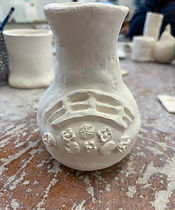
Title: Japanese Bridge Vase
Medium: Coil-built vase with sculpted bridge and lily pads
Artist: Myrahvai Tufte
Refelction
I really enjoyed working on this project, and overall I am very happy with how my vase turned out. At the beginning, I wasn’t sure how to turn Monet’s Japanese Bridge painting into a ceramic piece, but as I worked through each step, everything started to come together. I focused on keeping the vase smooth and clean while adding detailed elements like the bridge and lily pads, which ended up being my favorite parts of the artwork. I think these details clearly show the connection to Monet’s garden and help the piece feel more complete. I am proud of the shape of the vase and how carefully the details were attached. If I could change one thing about the project, it would be getting the piece its second firing so I could see how the final glaze colors would have turned out and fully complete the artwork.
About Claude Monet:
Claude Monet was a French Impressionist painter known for focusing on nature, light, and reflections. One of his most famous subjects was the Japanese Bridge he built in his own garden in Giverny. He painted it many times.
Why I Chose Monet:
I chose Monet because I really like the calm and relaxing look of his Japanese Bridge paintings. The colors are soft, and the scenery looks peaceful. I also thought the bridge and lily pads would be fun to try to recreate in clay. I liked the idea of bringing something from a 2D painting into a 3D ceramic piece. The bridge especially stood out to me, so I wanted it to be the main feature on my vase.